Most fit men dealing with gynecomastia are not trying to look like a fitness model.
They already train. They watch their body fat. They’ve built their chest.
And somehow, the chest still looks softer or puffier than the rest of the body.
That disconnect is frustrating because gynecomastia in fit men is not always an effort problem. You can build the pec. Glandular tissue does not care how much you bench.
That is where male chest anatomy matters.
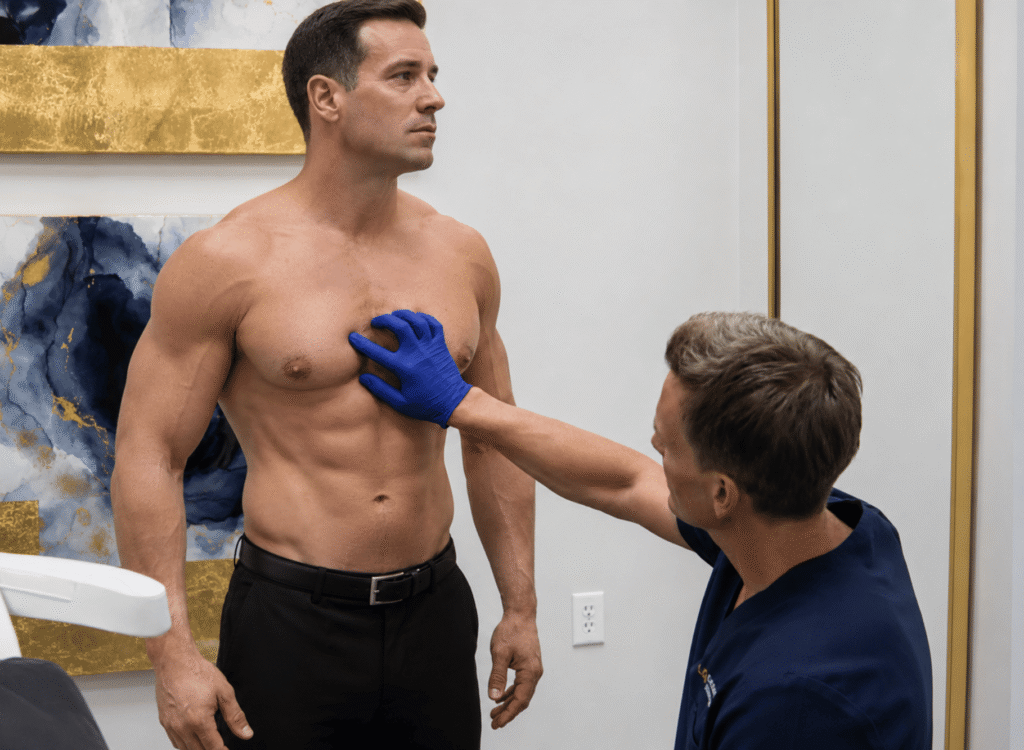
A strong-looking chest depends on more than size. Pectoral shape, gland distribution, surrounding fat, nipple and areola position, skin, and the transition into the shoulders and upper abdomen all influence how the chest reads.
At SCULPT, Dr. Beck evaluates those pieces together because the right answer for a lean, muscular man may be very different from the plan for someone carrying more surrounding chest fat.
You already did the work. The question is whether what is left can actually be trained away.
When You’re Lean, There’s Nowhere to Hide
You put in the work. The pec is there. The shoulders are there. The body fat is down.
Which means anything throwing off the chest becomes a lot easier to see.
In a lean or muscular guy, there isn’t much extra tissue to camouflage gland projection, puffy nipples, uneven contour, or a transition that just looks…off. Small differences can stand out more because the rest of the chest is already defined.
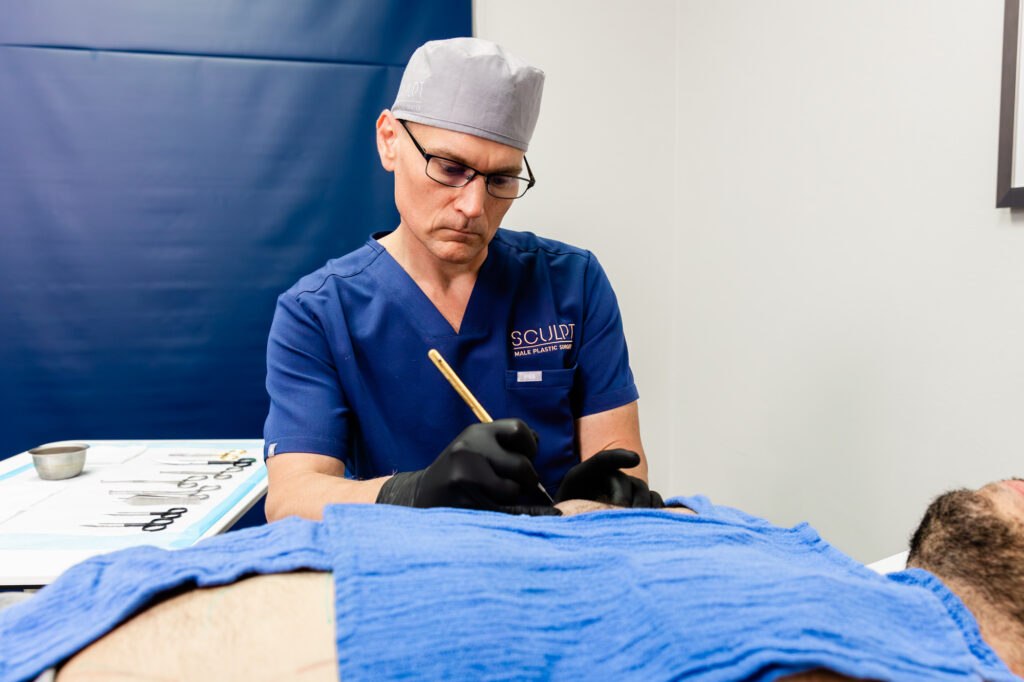
That is why Dr. Beck stays hands-on from start to finish. He removes the glandular tissue, performs the contouring, and closes the incisions himself.
The job isn’t to erase the chest you built. It’s to stop gyno from stealing the credit.
The final contour still has to work with your pecs, shoulders, nipple and areola position, and the frame you already have.
Because if you spent years building the architecture, surgery shouldn’t come in with a wrecking ball.
Why Getting Lean Can Make Gyno More Obvious
You’d think dropping body fat would solve the problem.
Sometimes it does the opposite.
As the fat around the chest decreases, glandular tissue beneath the nipple and areola can become more noticeable. The rest of the chest gets sharper, but the gland stays put.
That’s why some men say their gyno actually looks worse after they lean out.
The body fat listened. The gland didn’t.
For a fit guy, that distinction matters. If the chest problem is mostly gland, more cutting, more cardio, or another round of chest day may not change the part that’s bothering you.
And if you’re already lean, blindly adding liposuction isn’t automatically the answer either. Dr. Beck evaluates how much of the problem is gland, how much is surrounding fat, and how the tissue sits over the pectoral muscle before deciding what actually needs to be treated.
The Infinity Edge Procedure™: Remove the Gyno. Keep the Pec.
When you’re lean, there’s less room for surgical guesswork.
The gland may be the problem, but the chest around it is something you already worked to build. The point isn’t to flatten everything in sight. It’s to remove what doesn’t belong without erasing the architecture underneath it.
During the consultation, Dr. Beck determines whether the chest needs gland excision alone or whether surrounding fat also needs liposuction for contouring.
For some men, especially those carrying additional fat around the gland, liposuction helps refine the transition across the chest. For a lean guy with very little surrounding fat, it may add little or nothing to the surgical plan.
More surgery isn’t automatically better surgery.
Dr. Beck performs complete gland excision through his Infinity Edge Procedure™, placing the incision along the natural border of the areola where it can blend into the surrounding pigment as it heals.
When liposuction is part of the plan, he uses it strategically to:
- smooth the transition around the pec
- preserve natural muscle projection
- reduce contour irregularities
- blend the chest into the shoulder and upper abdomen
You built the chest. The surgical plan should respect it.
Recovery Without Losing Your Momentum
If training is part of your routine, being told to “take it easy” can feel like its own form of punishment.
But recovery is temporary. Protecting the result is the priority.
During the first few days, soreness, tightness and swelling are expected. Think hard chest day, except this time your pecs did not volunteer.
Dr. Beck encourages walking and light daily movement early in recovery to keep you moving without putting unnecessary stress on the chest. What you should not do is mistake “I feel pretty good” for “I’m cleared to bench.”
Feeling ready and being healed are not always the same thing.
Compression, activity restrictions and Dr. Beck’s post-operative instructions help control swelling and allow the chest to settle into its new contour. Most men gradually return to normal activity before they are cleared for heavier training, with more intensive workouts typically returning around the six-week mark based on individual healing and Dr. Beck’s clearance.
A few weeks off the gas beats doing something stupid and buying yourself extra recovery time.
Protect the Result While Your Chest Settles In
Recovery isn’t passive. SCULPT builds support around the weeks when swelling, compression, and patience matter most.
Lymphatic Drainage: Help the Swelling Move Along
Swelling is part of recovery. That does not mean you have to sit around and admire it.
SCULPT includes scheduled lymphatic drainage sessions during the early weeks after surgery. As part of that postoperative support, our team uses TempSure Firm, combining controlled radiofrequency energy with a specialized massage handpiece to support circulation and help manage swelling while the chest continues to settle.
These sessions can support:
- fluid movement
- swelling management
- comfort during recovery
- smoother contour refinement as healing progresses
The chest you see at week one is not the chest you’ll see at month six. Give the swelling time to get out of the way.
Compression: The Boring Part That Actually Matters
Nobody gets excited about wearing a compression garment for six weeks.
Wear it anyway.
Compression helps manage swelling and supports the chest while the skin and underlying tissues settle into their new contour. For a fit guy, that matters because the whole point is to let the definition underneath start showing through instead of fighting unnecessary swelling.
Dr. Beck requires compression for six weeks after gynecomastia surgery.
This is one of those times when following directions is more impressive than trying to tough it out.
As swelling continues to come down, the chest gradually looks sharper and more settled. The result you see early in recovery is not the finished product.
You did the hard part in the gym. Don’t get lazy with the easy part now.
This Is Where Reps Matter
You know the difference between doing something once in a while and doing it enough that the details become second nature.
Gynecomastia surgery is no different.
Dr. Beck performs more than 200 gynecomastia procedures each year, and male chest surgery is a major part of his practice. That repeated experience means he sees different gland shapes, chest builds, levels of muscle development, asymmetries, and contour challenges over and over again.
For a fit guy, that matters. You are not starting with a blank canvas. There is already muscle, definition, and proportion worth protecting.
You put in the reps building the chest. It makes sense to choose a surgeon who has put in the reps operating on one.
Still comparing your options? Read our guide on how to choose a gynecomastia surgeon in Dallas–Fort Worth.
Not Every Gyno Case Needs an Operating Room
If your chest is lean and the problem is primarily glandular tissue, the surgical plan may be simpler than you expect.
Many straightforward gland-only gynecomastia cases can be performed in-office at SCULPT under local anesthesia. You’re awake, comfortable, and the focus stays on removing the gland without adding procedures your chest does not need.
If there is more surrounding chest fat and liposuction is part of the plan, the case becomes more involved. Those procedures are typically performed under general anesthesia in an accredited surgical facility.
Same problem. Different chest. Different game plan.
Dr. Beck determines the appropriate setting during your consultation based on the amount of gland, surrounding fat, overall chest anatomy, and what is actually required to create the result.
You Should See the Pec, Not the Puffiness.
At a certain point, the frustration is less about the chest itself and more about how much attention it steals.
A fitted shirt becomes a calculation. Taking your shirt off becomes an angle check. Photos get a second look for all the wrong reasons.
You are not trying to look like someone else. You just want the chest to look clean, proportional, and like it belongs with the rest of you.
That can mean:
- wearing a fitted shirt without checking your chest first
- taking your shirt off without thinking about the angle
- seeing pectoral definition instead of nipple puffiness
- spending less mental energy managing one stubborn area
The real win? Your chest stops taking up space in your head.
What Gynecomastia Surgery Won’t Do
Gynecomastia surgery can remove the gland and improve the contour of the chest. It does not build the pec underneath it.
Think reveal, not replacement.
If you already have strong pectoral development, removing the tissue that is hiding or distorting it can make that definition easier to see.
If your goal goes beyond removing gyno and you also want more chest size, projection, or shape, that becomes a different conversation. Some men choose to combine gynecomastia surgery with custom pectoral implants to build the chest they cannot create through gland removal alone.
Removing what you don’t want and adding what you do want are two different jobs. Sometimes the best plan involves both.
A good result should still look like your chest. Just finally working in your favor.
Scars Shouldn’t Become the New Thing You Notice
Getting rid of gyno only to trade it for an obvious scar is not much of a win.
With the Infinity Edge Procedure™, Dr. Beck places the incision along the natural border of the areola, where the transition in pigment and texture can help the scar blend as it heals.
For fit men, that placement matters. The chest may be exposed at the gym, pool, beach, or basically anywhere a shirt becomes optional.
The goal is simple: fix the problem without advertising that you had it fixed.
Scar appearance continues to change over time, and healing varies from person to person, but careful incision placement and closure are part of the plan from the beginning.
You want people noticing the pec, not looking for the evidence.
You’ve Done the Work. Find Out What’s Actually Left.
You can keep cutting body fat, adding chest days, and changing shirts in the mirror.
Or you can find out whether what you’re seeing is actually glandular tissue that training was never going to remove.
Dr. Beck evaluates the gland, surrounding fat, pectoral development, and overall chest proportions to determine what is creating the problem and what, if anything, should be done about it.
No guessing. No automatic add-ons. No pretending another set of incline presses is going to solve anatomy.
If your chest still does not match the body you built, get a real answer.
Be understood. Be respected. Be yourself. At SCULPT.
Not ready to talk yet? Explore Treatment Options for Free.