Thinking seriously about gynecomastia surgery usually leads to a very different kind of Google search.
How bad is the recovery? When can I work out again? Will people see the scar? Do I need liposuction too? How long before my chest actually looks normal?
Basically: “Tell me what I’m getting into.”
Fair question.
Gynecomastia surgery can be straightforward for some men and more involved for others. The details of your chest determine which version you’re dealing with.
That also means your buddy’s recovery, incision, anesthesia, or surgical plan may have very little to do with yours.
So before you start planning around somebody else’s Reddit recovery timeline, start with the questions that actually matter.
Here are 10 of the gynecomastia surgery questions men ask us most.
1. What Does Dr. Beck Need to Determine Before Recommending Gynecomastia Surgery?
Before anyone starts talking about incisions, liposuction, or recovery time, there’s a more important question:
What is actually creating the shape of your chest?
For some men, the main issue is glandular tissue beneath the nipple. Others have gland plus surrounding chest fat. Skin quality, nipple position, asymmetry, previous surgery, and the overall structure of the male chest can also change what needs to be done.
That is why two guys who both say, “I have gyno,” may need very different surgical plans.
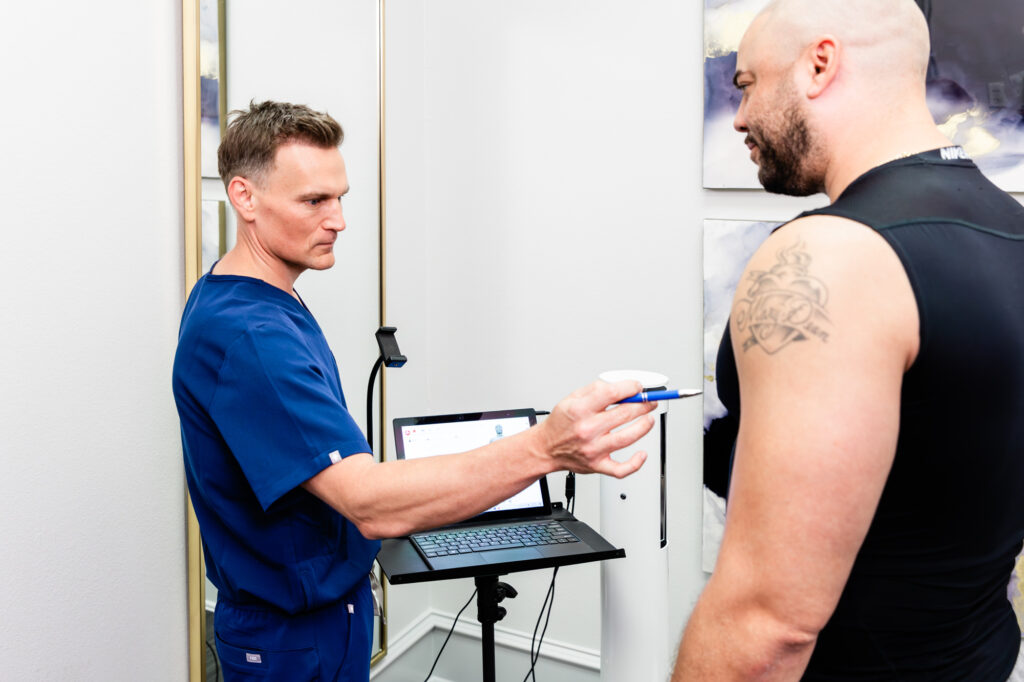
During a gynecomastia consultation, Dr. Beck evaluates the chest itself, along with your medical history, medications, previous treatments, and what you actually want the chest to look like afterward.
The goal isn’t to throw every available technique at your chest. It’s to figure out which ones your chest actually needs.
If you are still trying to determine whether what you see is gland, fat, or something else, our What Is Gynecomastia? guide breaks that down in more detail.
2. Will My Gynecomastia Surgery Be Done Under Local or General Anesthesia?
For a lot of men, this is one of the first questions that actually affects the calendar.
Do I need to go under general anesthesia, or can this be handled in the office?
At SCULPT, many straightforward gynecomastia cases involving gland removal without liposuction can be performed in-office under local anesthesia.
More complex cases, especially when there is additional chest fat that needs liposuction or more extensive contouring, are typically performed under general anesthesia at an accredited surgical facility.
Neither option gets a gold star. The right one is the one that matches the work your chest actually needs.
Dr. Beck determines the anesthesia plan based on the extent of correction your surgery requires.
For some men, an in-office procedure under local anesthesia means fewer moving parts and a more streamlined experience. For others, general anesthesia gives Dr. Beck the operating environment needed to perform a more involved chest correction safely and precisely.
Your calendar may care whether you have a board meeting Thursday or chest day Saturday. Your surgical plan does not.
The procedure should be built around your anatomy first. Then we plan the logistics around your life.
3. Will I Need Liposuction With Gland Removal?
Maybe. But liposuction is not automatically part of every gynecomastia surgery.
If glandular tissue beneath the nipple is the main problem and the surrounding chest is already lean, gland excision alone may be enough.
If there is additional fatty tissue across the chest, liposuction can help blend the correction into the surrounding anatomy and improve the overall contour.
Think of it this way: removing the gland handles the problem. Contouring handles the transitions around it.
That distinction matters, especially in men with a broader chest, significant weight changes, or enough surrounding fat that gland removal by itself could leave the result looking unfinished.
Dr. Beck evaluates how the gland, fat, skin, and existing muscle structure work together before deciding whether liposuction adds value.
Because “while we’re in there” is not a surgical strategy.
Some men need both. Some do not.
And for the guy who has already spent years dialing in his body composition, adding a procedure he does not need is not an upgrade. It is just more procedure.
If chest fat is part of your surgical plan, learn more about liposuction for men and how Dr. Beck approaches male body contouring.
4. What Are the First Few Days After Gynecomastia Surgery Actually Like?
The first few days are usually less dramatic than guys imagine, but they are still recovery days.
Translation: clear some space on the calendar and let your chest be boring for a minute.
Swelling, tightness, bruising, soreness, and temporary changes in sensation can all be part of the early healing process. You may also have dressings, compression, or drains depending on exactly what was done.
How you feel will depend heavily on the procedure.
A straightforward gland-only case performed in the office can have a very different first few days than a more involved surgery that includes liposuction, additional contouring, or excess skin removal.
That is why comparing your recovery to your friend’s, a guy at the gym, or somebody documenting Day 2 on Reddit only gets you so far.
Same diagnosis does not mean same operation. Same operation does not always mean same recovery.
Dr. Beck will give you specific instructions based on your procedure, but early recovery generally means protecting the chest, keeping activity light, walking as directed, and avoiding the lifting, pushing, pulling, or upper-body heroics your body did not ask for.
The first few days have one job: give the work Dr. Beck just did a clean start.
5. How Soon Can I Go Back to Work After Gynecomastia Surgery?
For most men, this is less about bravery and more about logistics.
How many days do I actually need off without turning my calendar into a crime scene?
The answer depends on what your surgery involves and what “work” means for you.
For desk-based or remote work, some men may feel ready to return within a few days. A physically demanding job usually requires more time.
Being able to open a laptop is not the same thing as being fully recovered.
You may feel capable of answering emails or sitting through a meeting before your chest is ready for long days, heavy bags, airport sprints, or pretending your carry-on weighs nothing.
Dr. Beck will give you a return-to-work plan based on your actual procedure, but the smart move is to build in enough margin that recovery does not become another item you are trying to outperform.
Your inbox can survive without you. Your chest gets one shot at the early healing phase.
If your schedule includes frequent travel, physical work, or a major event, bring that up during your consultation so the surgical timing can be planned around real life instead of wishful thinking.
6. When Can I Work Out Again After Gynecomastia Surgery?
This is usually the question gym guys ask before Dr. Beck has even finished explaining the recovery.
“Cool. So when can I bench again?”
For upper-body training, think in terms of weeks, not days. More involved chest surgery can require a longer break before lifting is cleared.
Early on, walking is generally encouraged as directed, but lifting, pushing, pulling, and strenuous upper-body activity need to wait until the chest has had time to heal.
And yes, that includes the creative workarounds guys come up with when they really want to get back in the gym.
“I’ll just go light” is still lifting. “I’m only training legs” can still involve bracing, gripping, loading plates, and moving weight around.
The bigger issue is not losing a week or two of progress. It is creating unnecessary swelling, stress, or force across a chest that is still healing.
You spent years building the pecs. Give Dr. Beck a few weeks to stop you from messing up the part sitting on top of them.
Dr. Beck will clear activity in stages based on your procedure and how your chest is healing. More extensive cases may require a longer runway before upper-body training resumes.
The smart move is simple: follow the recovery plan you were actually given, not the one you found from a guy online who had a completely different operation.
7. Where Will the Scar Be After Gynecomastia Surgery?
Let’s get one thing out of the way:
Surgery leaves a scar.
Anyone promising you an invisible incision is getting a little too creative with the sales pitch.
For many gynecomastia cases, Dr. Beck places the incision along the natural border of the areola using his Infinity Edge Procedure™. That transition between the areola and surrounding chest skin helps camouflage the incision as it heals and matures.
And when it comes time to close the incision, Dr. Beck does that himself.
He personally sutures his gynecomastia patients rather than handing off the final closure to another member of the surgical team. It may sound like a small detail, but when the incision sits on a chest you plan on living with for a very long time, details matter.
You hired the surgeon. Dr. Beck believes the surgeon should finish the job.
The goal is not to pretend the scar does not exist. It is to place it somewhere your eye has less reason to notice it and give the closure the same level of attention as the correction underneath it.
Scar appearance varies from man to man based on skin type, genetics, healing, sun exposure, postoperative care, and the extent of surgery performed.
More complex cases may also require additional or longer incisions, particularly when significant excess skin has to be removed.
That is an important tradeoff to understand before surgery.
If a larger correction requires a larger incision, Dr. Beck would rather explain that upfront than sell you a fantasy and let your mirror break the news later.
During your consultation, he can show you where your incision is likely to be, why that location makes sense for your chest, and what kind of scar you should realistically expect.
8. When Will My Chest Actually Look Normal After Gynecomastia Surgery?
You will usually notice that the chest looks different right away.
That does not mean it is finished.
Early swelling, bruising, firmness, temporary asymmetry, and changes in how the skin or nipple area looks can all be part of the healing process.
In other words, Day 3 is not the time to start conducting a quarterly performance review on your chest.
The contour continues to change as swelling comes down, tissues soften, and the chest settles into its new shape.
How quickly that happens depends on what was done. A smaller gland-only correction may settle differently than a case involving liposuction, more extensive contouring, or excess skin removal.
The first result you see is the beginning of the result, not the final draft.
That is also why Dr. Beck follows the chest through recovery rather than judging the outcome from one early snapshot.
For guys who are used to tracking numbers, photos, weight, body fat, or progress in the gym, recovery can test your patience a little.
Your chest is healing. It is not behind schedule because it did not hit a KPI by Friday.
The best thing you can do is follow your postoperative instructions, give swelling time to resolve, and let Dr. Beck tell you when what you are seeing is part of normal healing versus something that needs attention.
Final refinement takes time, but the direction of the change is often visible much earlier.
9. Can Gynecomastia Come Back After Surgery?
This is where words like “permanent” deserve a little supervision.
When established glandular gynecomastia is fully excised, the goal is a long-lasting correction with a lower risk of residual fullness.
That is an important part of Dr. Beck’s approach. For persistent glandular gyno, he focuses on complete gland excision while preserving the anatomy needed to create a natural male chest contour.
But no responsible surgeon should tell you that your chest now comes with a lifetime force field.
Future hormone changes, certain medications or substances, anabolic steroid use, significant weight changes, and other medical factors can still change the appearance of the chest later.
There is also an important difference between residual gynecomastia and true recurrence.
If glandular tissue was not fully addressed during the original surgery, a man may continue to see or feel fullness afterward. That is not necessarily gyno “coming back.” Sometimes it never fully left.
There’s a difference between the problem returning and the problem never being completely solved in the first place.
Dr. Beck sees men seeking revision after previous gynecomastia procedures, which is one reason he pays close attention to what tissue is actually present and what needs to be removed during the original operation.
The other half of the equation is understanding whether there is an ongoing factor that deserves attention before or after surgery.
Think long-term result, not lifetime warranty.
The better question is not, “Can anyone promise this will never change again?”
It is:
“Are we treating the right problem completely, and have we addressed anything that could keep working against the result?”
10. What Should I Expect at a Gynecomastia Consultation in Dallas–Fort Worth?
By this point, you can Google yourself into a pretty impressive education on gyno.
What Google cannot do is examine your chest.
A gynecomastia consultation with Dr. Beck is where the general information gets replaced with answers that actually apply to you.
He will evaluate the glandular tissue, surrounding chest fat, skin quality, nipple position, asymmetry, previous surgery if applicable, and the overall structure of your chest. Your medical history, medications, hormone-related concerns, and what you want to change also become part of the conversation.
From there, the questions get much more useful:
- Do I actually need surgery?
- Is gland excision enough, or would liposuction improve the contour?
- Would my procedure make sense under local or general anesthesia?
- Where would my incision be?
- What should I realistically expect from recovery?
- When can I return to work, travel, and training?
- What should my chest realistically look like afterward?
This is not the part where every guy gets handed the same surgical playbook.
Dr. Beck builds the recommendation around the chest in front of him. Some men need a relatively straightforward gland excision. Others need a more involved correction. And some men may need a different conversation altogether.
That matters when you are deciding whether surgery is worth your time, recovery, money, and trust.
Executives call it due diligence. Gym guys call it having a plan. We call it knowing what you’re signing up for.
SCULPT is located in Frisco and treats men throughout Dallas–Fort Worth who want straight answers about gynecomastia before making a decision.
If you are still comparing surgeons, our guide to choosing a gynecomastia surgeon in Dallas–Fort Worth explains the experience, questions, and credentials worth looking at.
And when you are ready to stop researching your chest and start getting answers about your chest, that is what the consultation is for.

Why Men Choose Dr. Beck for Gynecomastia Surgery in Dallas–Fort Worth
By the time most men reach this point, they are not looking for more marketing.
They are looking for confidence in the decision.
That means knowing the surgeon understands the male chest and has enough experience to make judgment calls when the case is not textbook.
Dr. Beck performs more than 200 gynecomastia procedures each year and treats men across the spectrum, from relatively straightforward gland-only cases to more complex primary and revision chest surgery.
But volume alone is not the point.
Experience should make the plan more precise, not just make the surgeon busier.
SCULPT was built around male plastic surgery, which means gynecomastia is not a side procedure squeezed into a broader cosmetic menu. The consultation, surgical planning, recovery conversations, and follow-up are designed around how men actually think about this decision: results, privacy, downtime, efficiency, and knowing exactly what they are signing up for.
For some guys, that means getting back to training.
For others, it means getting through a board meeting, business trip, beach weekend, or locker room without thinking about their chest first.
Different guy. Same goal: handle it correctly and move on with your life.
If you want to learn more about the surgeon behind the plan, meet Dr. Daniel Beck.
Ready for an Answer About Your Chest?
You have the questions. The next useful step is getting answers about your chest.
For men considering gynecomastia surgery in Dallas–Fort Worth, a consultation with Dr. Beck is where you find out what your chest actually needs, what it does not need, and what the road from surgery to recovery would realistically look like for you.
No generic surgical package. No unnecessary add-ons. Just a recommendation you can actually make a decision on.
You bring the questions. Dr. Beck brings the experience to answer them.
And if you are still in research mode, that is fine too. Knowing what you are dealing with is the first useful decision.
Your chest has probably had enough committee meetings. Get the information and make the call.
Not ready to talk yet? Build Your Treatment Plan