Your Jawline Does Not Usually Disappear Overnight
Most men do not wake up one morning with a completely different jawline.
The change is quieter than that.
A dress shirt no longer frames your neck the way it used to. Your profile looks softer in photos. The angle between your jaw and neck is harder to find, even though your weight, workouts, and eating habits have not changed much.
Naturally, you blame fat.
Maybe you need to lose five pounds. Maybe the weekend meals finally filed a complaint. Maybe gravity has simply decided to become more involved in your life.
It is a logical conclusion.
It is also frequently incomplete.
Fat beneath the chin can absolutely reduce jawline definition. But it is only one of several reasons a man’s lower face may begin to look softer, heavier, or less structured.
Chin projection matters. Jaw width matters. Skin quality matters. Facial and neck muscles matter. Jowling, genetics, aging, and changes in weight can all influence how clearly the jaw separates from the neck.
That is why two men with similar builds and nearly identical body-fat percentages can have completely different profiles.
One may have localized fullness beneath the chin.
Another may have strong bone structure hidden beneath loose tissue.
A third may be dealing with limited chin projection rather than excess fat at all.
They may point to the same place in the mirror, but they do not have the same problem.
This distinction is especially important in men. The chin, jaw, neck, and lower third of the face carry much of the visual strength associated with masculine facial structure. Treating that area without understanding the underlying anatomy can create more width without more definition, reduce fat without improving the profile, or tighten skin while leaving the structural imbalance untouched.
Before choosing a treatment, you need to know what is actually changing.
The best result starts with identifying what is actually weakening the jawline.
What Actually Creates Jawline Definition in Men?
A strong jawline is not one feature.
It is the relationship between the chin, jaw, and neck.
The chin anchors the lower face. The mandibular border creates the visible line running toward the ears. The jaw angles add width and strength near the back of the face. The neck provides contrast, allowing that structure to stand out rather than blend into the throat.
When those elements are balanced, the lower face looks stronger, cleaner, and distinctly masculine.
Not oversized.
Not cartoonishly square.
Just well proportioned.
Chin Projection
Chin projection has a major influence on the profile. A chin that extends far enough forward helps create separation between the face and neck.
From the front, it also supports balance through the center of the lower face.
This is why jawline definition cannot be judged only by looking at the sides of the jaw. The chin may be the quietest part of the structure, but it often carries the entire profile.
Jaw Width and Angle
The width of the jaw and the angle near the ears help create the broader lower-face proportions commonly associated with masculine facial structure.
The goal is not maximum width.
Too much width can make the lower face look heavy or artificial. The strongest result is usually one that fits the cheekbones, chin, neck, and overall proportions of the face.
The Jaw-to-Neck Transition
A defined jawline requires a visible break between the lower face and neck.
Think of it as contrast. Even strong bone structure can appear less prominent when the transition beneath the jaw is not clear.
This is why the jaw and neck should always be evaluated together. Improving one while ignoring the other can leave the profile looking unfinished.
Male facial aesthetics is not about adding bulk wherever a sharper angle sounds appealing. It is about understanding proportion, projection, and how each feature supports the next.
A masculine jawline should look like it belongs to the man wearing it, not like it was borrowed from someone else’s blueprint.
Why Does a Man’s Jawline Begin to Disappear?
A softer jawline usually comes down to one or more changes happening beneath the surface.
Sometimes the cause is obvious.
Often, it is a combination.
Fullness Beneath the Chin
Localized fat beneath the chin can blur the mandibular border and reduce the separation between the face and neck.
Weight gain may contribute, but genetics also matter. Some men remain lean through the chest and waist while stubborn fullness stays parked beneath the chin as if it signed a long-term lease.
When fat is the primary issue, the jawline may already be strong. It is simply hidden.
Limited Chin Projection
Some men never had significant forward chin projection to begin with. Others notice the imbalance more as the surrounding tissues change with age.
A recessed or underprojected chin can make the neck appear fuller and the jawline look shorter from the side. This can create the appearance of a double chin even when very little excess fat is present.
In this situation, reducing fullness alone may improve the neck but leave the profile looking underpowered.
Skin Laxity
Skin gradually loses collagen, elasticity, and its ability to follow the underlying structure as closely as it once did.
Early laxity may slightly soften the edge of the jaw. More advanced laxity can create loose tissue beneath the chin or along the neck.
The framework may still be strong.
The skin is simply no longer wrapping it as tightly.
Jowling and Tissue Descent
A jawline looks sharp because the border is continuous.
Jowls break that line.
As facial tissues begin to shift downward, fullness can collect along the lower cheeks and cross the edge of the jaw. Even a relatively small change can make the lower face look heavier.
This is not always new fat. In many cases, it is existing tissue that has changed position.
Changes in Facial Support
Facial aging is not limited to skin and fat. Changes in muscles and deeper supporting structures can also influence how the tissues of the face are positioned.
This may show up as reduced cheek support, greater heaviness through the lower face, or an earlier loss of definition around the jaw.
It is one of the least obvious causes because most men are not standing in front of the mirror analyzing facial muscle support.
They see a softer jawline and blame lunch.
Weight Loss Can Expose a Different Concern
Losing weight may improve jawline definition when general or localized fat is responsible.
But weight loss cannot increase chin projection, reposition jowls, or fully tighten skin that has lost significant elasticity.
After substantial weight loss, some men actually notice more looseness through the face and neck because the volume beneath the skin has decreased.
The scale may have solved one problem while revealing another.
The important takeaway is simple: a double chin, weak profile, loose neck, and broken jawline can look similar at first glance.
They are not the same concern.
Identifying which change is responsible determines whether the best approach involves reducing fat, rebuilding structure, improving muscle and skin support, repositioning tissue, or combining more than one strategy.
The cause matters because jawline treatments do very different jobs. Some reduce fat. Some rebuild structure. Others improve skin, muscle support, or tissue position.
Here is where each option fits.
How Can Men Improve Jawline Definition?
There is no universal jawline treatment.
That may be inconvenient for anyone hoping one syringe, device, or aggressive diet will solve every version of the problem. The jawline does not care which treatment is currently trending.
It responds to what is actually causing the change.
At SCULPT Aesthetic Center, options can range from wellness and nonsurgical treatments to facial surgery. The right approach may focus on reducing fat, strengthening support, improving contour, repositioning tissue, or combining treatments that address different layers.
Medical Weight Loss for Broader Changes in Body Fat
When jawline changes appear alongside increased body fat, medically supervised weight loss may be an appropriate place to begin.
Improving overall body composition can reduce facial and neck fullness for some men while supporting larger health and performance goals. It also gives the provider a clearer view of which concerns were related to weight and which ones remain after weight loss.
Medical weight loss is not, however, a remote control for one stubborn pocket beneath the chin. Genetics, skin quality, facial structure, and fat distribution still have a vote.
Kybella for Localized Fat Beneath the Chin
Kybella is an injectable treatment designed for moderate to severe fat beneath the chin, also known as submental fat. It may be considered when localized fullness is the primary concern and the surrounding skin has enough elasticity to follow the changing contour.
Kybella does one specific job.
It targets fat beneath the chin.
It does not build a recessed chin, lift jowls, strengthen facial muscles, or remove loose skin. That specificity can be valuable for the right candidate and disappointing for the man expecting it to remodel his entire lower face.
Neck Liposuction for More Direct Fat Reduction
Neck liposuction may be considered when localized fat beneath the chin or along the upper neck is significantly obscuring an otherwise strong jawline.
Unlike general weight loss, it directly removes fat from the targeted area. It may also create a more immediate and controlled change than an injectable approach for selected surgical candidates.
The quality of the surrounding skin still matters. Removing fat can reveal stronger definition, but it cannot force significantly loose skin to tighten or correct a chin that lacks projection.
When the anatomy is right, neck liposuction does not build a new jawline.
It uncovers the one already there.
EmFace for Facial Muscle and Skin Support
EmFace takes a different approach. Rather than removing fat or adding volume, the technology is designed to stimulate facial muscles while addressing the skin. It may be considered for men noticing early facial softening, reduced support, or skin changes who want a nonsurgical option.
This is an important distinction because most facial treatments focus primarily on the surface or replace volume.
EmFace brings the muscle layer into the conversation.
To understand why that muscle layer matters, read how EmFace works for men and why facial aging is not only a skin problem.
That does not make it the answer for every jawline concern. It will not remove significant submental fat, create major chin projection, or replace surgery when loose tissue and jowling are advanced.
Jawline Filler for More Contour and Definition
Jawline filler can add targeted definition through selected areas of the lower face. Depending on the anatomy, it may help reinforce the mandibular border, improve symmetry, support the chin, or create a cleaner transition through the jaw.
The operative word is targeted.
More filler does not automatically create more definition. On a face that is already broad or heavy through the lower third, added volume can create bulk instead of structure.
A well-planned result should look stronger.
Not inflated.
Chin Augmentation for Structural Projection
When limited chin projection is weakening the profile, the solution may need to begin at the front of the jaw.
Injectable filler can provide temporary chin enhancement for selected patients. A chin implant offers a surgical option for creating more lasting projection, width, or balance through the lower face. Chin surgery is specifically used to reshape or enhance the chin, including through implant placement.
This can improve more than the chin itself.
Increasing projection may create a stronger endpoint for the jawline and improve the visual relationship between the face and neck. The change can be especially meaningful from the side, where an underprojected chin often makes surrounding fullness appear more prominent.
Sometimes the jawline does not need to be wider.
It needs a better anchor.
PDO Threads for Earlier Tissue Descent
PDO threads may be considered when tissue has begun to shift, but the degree of laxity does not yet warrant facial surgery.
Absorbable, barbed sutures are placed beneath the skin to provide a lifting effect in selected areas of the face and neck. They may help improve early jowling or restore a cleaner border along the jaw in carefully chosen patients.
Threads occupy a useful middle ground.
They are more involved than a skin treatment but less extensive than a facelift. They should not be presented as a miniature facelift or expected to correct significant loose skin.
A lighter tool still needs a lighter job.
Facelift or Neck Lift for More Advanced Tissue Changes
When jowls, loose skin, displaced tissue, or neck aging are driving the concern, surgery may offer the most meaningful correction.
A facelift addresses visible facial aging that can include jowls and descended tissue. A neck lift focuses on signs of aging through the jawline and neck and may involve excess skin, fat, or muscle-related concerns.
For the right patient, surgery does something nonsurgical treatments cannot:
It repositions and removes tissue rather than asking another treatment to camouflage it.
That does not make surgery the automatic answer. It makes it the appropriate answer when the anatomy calls for more than subtle support, added contour, or modest tightening.
The best jawline plan may involve one treatment or several working together. What matters is that each one has a clear assignment.
No freelancing. No filler trying to perform a facelift’s job. No weight-loss plan being blamed for a recessed chin.
Just the right tools aimed at the right layers.
The Mirror Shows the Complaint. The Evaluation Finds the Cause.
Most men arrive knowing exactly what they do not like.
The jaw looks softer. The neck looks heavier. The profile is not pulling its weight.
What they usually do not know is why.
And to be fair, no one should need an advanced degree in facial anatomy to look in the mirror. You see the change. It is Dr. Beck’s job to determine what is creating it.
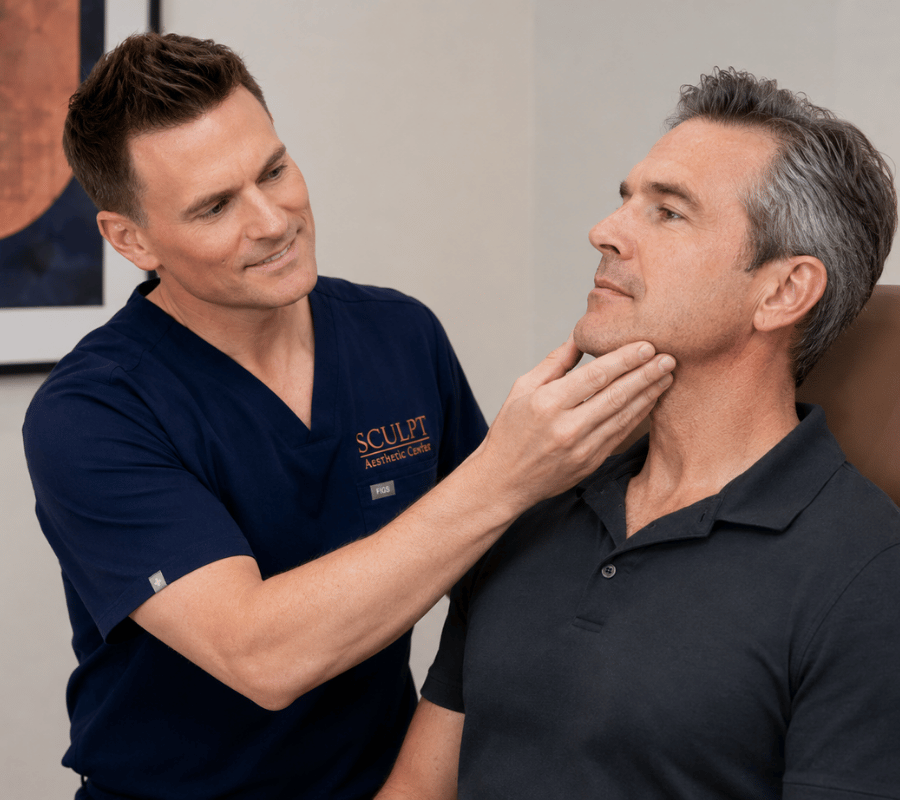
A male jawline evaluation should look beyond the single area a patient points to. Dr. Daniel Beck studies the face from the front, profile, and three-quarter views because each angle tells a different part of the story.
He evaluates:
- Chin projection and width
- The shape and visibility of the mandibular border
- Fullness beneath the chin
- Jaw-to-neck separation
- Skin quality and elasticity
- Early or advanced jowling
- Facial and neck support
- The balance between the lower face and the rest of the features
He also considers whether recent weight changes, genetics, or natural facial aging are contributing to the concern.
This matters because the lower face operates as a unit. A change to the chin can alter the appearance of the neck. Reducing fat may reveal excellent structure or expose laxity that was previously less noticeable. Adding volume may strengthen the right face and overload the wrong one.
The jawline gets no points for being simple.
Fortunately, SCULPT is not limited to one way of treating it.
Our 360 approach combines plastic surgery, medical aesthetics, and wellness, allowing the recommendation to follow the anatomy instead of being forced toward whichever product or device happens to be available.
For one man, that may mean improving body composition before considering a facial treatment. For another, it may involve a nonsurgical option that supports the skin or facial muscles. Someone with limited chin projection may need structural enhancement, while advanced jowling or neck laxity may call for surgery.
Sometimes one treatment is enough.
Sometimes several layers need to be addressed in sequence.
The goal is not to check every box on the treatment menu. It is to build a plan in which every recommendation has a reason for being there.
Because a stronger jawline should look intentional.
The treatment plan should be, too.
Is Jawline Filler the Right Answer for Men?
Sometimes.
That may not be the most dramatic answer, but it is the honest one.
Jawline filler can be an excellent option when a man has good underlying structure and needs more definition through specific areas of the lower face. It may help reinforce the mandibular border, improve symmetry, support the chin, or create a stronger transition between the front and sides of the jaw.
Used strategically, it can sharpen the framework without making the result obvious.
Used without a clear plan, it can turn “more defined” into “why does my face suddenly look wider?”
That distinction matters in men.
A broader lower face may look strong when the proportions are balanced. But adding volume to a jaw that is already heavy, poorly supported, or covered by loose tissue can create bulk rather than structure.
Jawline filler may be worth considering when:
- The jaw needs targeted reinforcement
- Chin projection is mildly limited
- There is asymmetry along the mandibular border
- Skin laxity is minimal
- The goal is a nonsurgical, temporary improvement
It may be less effective when the primary concern is:
- Significant fat beneath the chin
- Advanced jowling
- Loose neck skin
- Greater structural deficiency
- A lower face that is already broad or heavy
This is why the phrase “jawline filler” can be slightly misleading.
The best results are not always created by filling the entire jawline. Sometimes the chin needs more attention than the jaw. Sometimes one area needs support while another should be left alone. Sometimes filler should not be invited to the meeting at all.
At SCULPT, the goal is not to see how much product can fit along the mandibular border.
It is to determine whether filler can create enough improvement to justify using it.
For the right man, it can be a powerful tool.
For the wrong anatomy, it is simply more volume wearing a very confident marketing label.
When a Softer Jawline Calls for More Than One Solution
A jawline can lose definition in more than one layer.
When that happens, asking one treatment to do all the heavy lifting usually leads to compromise.
SCULPT’s 360 approach brings wellness, nonsurgical aesthetics, and plastic surgery into the same conversation. This allows each concern to be addressed at the level where it begins, whether that means improving body composition, supporting the skin and facial muscles, reinforcing structure, or repositioning tissue.
More treatment is not automatically better.
Better matched is better.
Sometimes one option restores the line.
Sometimes the jawline has assembled a committee.
Either way, the result should fit the man’s facial structure, goals, and tolerance for downtime. It should look stronger without looking borrowed, overbuilt, or obviously treated.
Frequently Asked Questions About Jawline Definition in Men
Can men improve jawline definition without surgery?
Yes, depending on what is causing the concern. Nonsurgical options may include medical weight loss, Kybella, EmFace, jawline filler, or PDO threads.
These treatments perform different jobs, so candidacy matters. Significant jowling, loose neck tissue, or limited structural support may require a surgical option to create the degree of improvement a patient wants.
How can I tell whether my double chin is fat or loose skin?
It can be difficult to tell from the mirror alone, especially when localized fat and skin laxity are both present.
A proper assessment considers the amount of fullness beneath the chin, skin elasticity, chin projection, neck anatomy, and whether the tissue changes when the head moves. What looks like a double chin may also be influenced by an underprojected chin or reduced jaw-to-neck separation.
Is jawline filler or chin augmentation better for men?
Jawline filler offers temporary, adjustable contouring and may work well when selected areas need modest reinforcement. Chin augmentation can provide stronger and more lasting structural projection when the chin is significantly underprojected.
Neither option is automatically better. If the primary concern is loose skin, jowling, or fat beneath the chin, adding structure alone may not fully improve the jawline.
Can multiple jawline treatments be combined?
Yes. Combination treatment may be useful when more than one anatomical layer is contributing to the concern.
For example, one option may address fullness beneath the chin while another improves chin projection, skin quality, or tissue position. Treatments may also be performed in stages so each result can be evaluated before the next step is considered.
More treatment is not the goal.
Better coordination is.
At SCULPT Aesthetic Center in Frisco, men from Dallas and across North Texas have access to an approach that treats male facial aesthetics as a primary focus, not a side category.
Ready to Put Definition Back on the Agenda?
Get started with our online Treatment Builder, a free and easy way to share what you are noticing, explore relevant options, and connect with the SCULPT team.
A stronger profile is not just a thought.
It can be your next move.